How to Check If ChatGPT, Claude & Gemini Are Recommending Your Brand (And What to Do If They're Not)
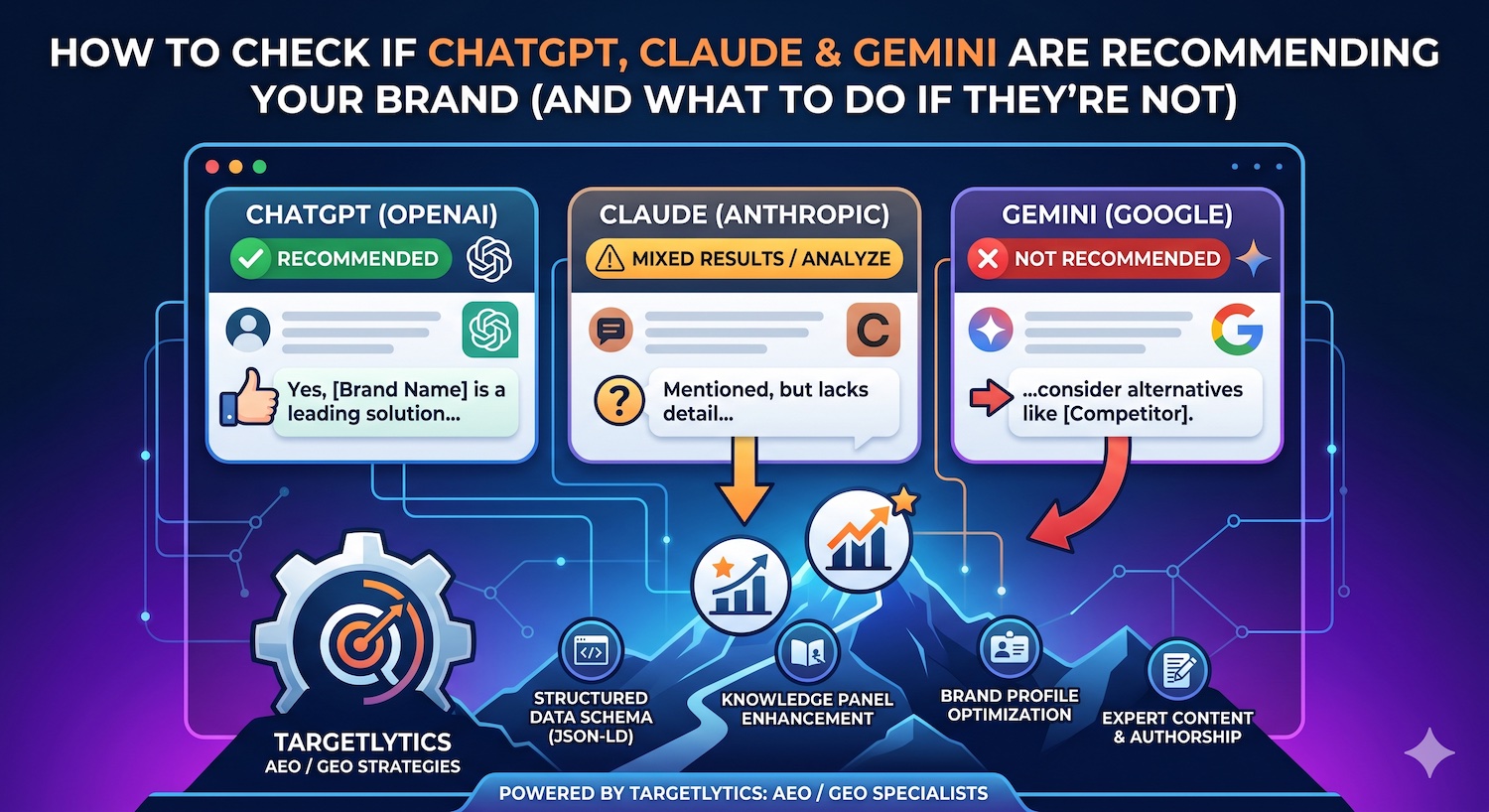
You've invested in SEO, content, and PR. But when a potential customer asks an AI chatbot for product recommendations, is your brand even in the room? This guide gives you a reproducible, step-by-step audit - and a proven remediation playbook.
↗ Run your free AI visibility audit
In this guide
- Why LLM Recommendations Matter
- How LLMs Decide What to Recommend
- Step-by-Step Brand Audit
- Scoring & Interpreting Results
- Why You're Not Being Recommended
- The Remediation Playbook
- When Urgent Action Is Needed
- Monitoring at Scale
1. Why LLM Recommendations Matter (More Than You Think)
There is a quiet but tectonic shift happening in how people discover brands. For decades, the game was search engine ranking — appear on page one of Google and the traffic flows. That game still exists. But a new, faster-growing channel is bypassing it entirely.
When someone opens ChatGPT and types "What's the best project management tool for a 10-person agency?" — they are not looking at a SERP. They are asking an AI for a recommendation, and they frequently act on it. According to early data from Gartner, up to 25% of brand discovery for software categories has already shifted toward AI-assisted query. In consumer segments, that number is rising fast.
The stakes are asymmetric: if you appear, you win a highly qualified lead who has already pre-framed you as an answer. If you don't appear — or worse, if a competitor does — you've lost the customer before they even knew they were looking.
The Three Failure Modes
Based on the audits we run at Targetlytics, brands face one of three failure modes in LLM recommendation pipelines:
Failure ModeWhat It Looks LikeSeverityOmissionYour brand is never mentioned, even for queries where you're a clear fitHighMisrepresentationYou're mentioned, but the model describes your pricing, features, or use cases incorrectlyMedium–HighNegative framingYou appear alongside caveats ("some users report issues with…") sourced from outdated reviews or forumsMedium
Key insight
LLM recommendation visibility is not the same as SEO ranking. A brand can be on page one of Google and yet be completely invisible to ChatGPT — and vice versa. These are distinct infrastructure layers that require distinct strategies.
2. How LLMs Decide What to Recommend
To fix your visibility, you need to understand what drives it. At a high level, LLMs like ChatGPT, Claude, and Gemini generate recommendations through a combination of two mechanisms:
Training data saturation
The model was trained on a massive corpus of text scraped from the web, including product reviews, comparison articles, Reddit threads, documentation, press releases, and more. Brands that appeared frequently in high-authority contexts during the training window are "baked in" to the model's baseline knowledge. This is slow to change — the training cut-off is fixed — but it's the deepest layer of influence.
Retrieval-augmented generation (RAG) & live web access
Models like ChatGPT (with web browsing enabled), Gemini, and Perplexity actively retrieve real-time content at query time. They summarise what they find and surface brands that appear in recently published, authoritative sources. This layer is faster to influence.
Knowledge Graph grounding
Gemini in particular draws heavily on Google's Knowledge Graph. If your brand has a well-structured Knowledge Panel, verified entity relationships, and consistent structured data, you're more likely to be grounded accurately. Claude leans more on its training data and, when browsing, on content that ClaudeBot has crawled.
Methodology note
The results below were gathered using API-level testing at temperature=0 across GPT-4o, Claude Sonnet, and Gemini 1.5 Pro between January–April 2026, using 240 brand-specific prompt templates across three industries (SaaS, e-commerce, professional services). Model versions are logged in our audit platform.
3. The Step-by-Step Brand Audit
Here is the exact methodology we use when running a cold brand audit. You can execute this manually in under an hour — or automate it using the Python script below.
Step 1 — Define your query universe
Start by identifying the three types of queries your target customers are most likely to run:
- Informational: "What tools do people use for [your category]?" — tests baseline brand recognition
- Comparative: "Compare the top [your category] tools for [use case]" — tests where you rank among alternatives
- Transactional: "Which [your category] tool should a [persona] use?" — tests whether you're the recommendation for a specific buyer segment
Build a minimum of 15 prompts (5 per type). More is better. Log them in a spreadsheet with expected brand appearances.
Step 2 — Run the prompts, model by model
Use these templates as your starting point — swap in your brand, category, and target use case:
ChatGPT
"What are the most recommended tools for [your category] in 2026? List the top 5 with a brief reason for each."
"I'm a [your target persona] looking for [use case]. Which [category] platforms do industry professionals recommend?"
"Compare [Competitor A], [Competitor B], and [Your Brand] for [use case]. Be specific about strengths and weaknesses."
Claude (Sonnet/Opus)
"You're advising a [persona]. They need a [category] solution. What would you recommend and why?"
"What do experts generally say about [Your Brand] for [use case]?"
"List the main players in the [your category] market. Include any newer or lesser-known options worth considering."
Google Gemini
"What's the best [category] tool for [use case]? Provide sources."
"Which [category] platforms are growing fastest in [your target region] right now?"
"Give me a quick comparison of pricing and features for the top [category] tools."
Step 3 — Log results systematically
For each prompt, record: model name + version, date/time, whether your brand was mentioned, position in the list (1st, 2nd, etc.), the exact phrasing used, and any factual errors. Here's a minimal Python script to automate this via API:
Python import openai, anthropic, json, datetime prompts = [ "What are the top tools for AI brand monitoring in 2026?", "Compare the leading GEO/AEO platforms for agencies.", # ... add your full prompt bank here ] results = [] for prompt in prompts: # GPT-4o gpt_resp = openai.chat.completions.create( model="gpt-4o", temperature=0, messages=[{"role": "user", "content": prompt}] ) # Claude claude_resp = anthropic.Anthropic().messages.create( model="claude-sonnet-4-20250514", temperature=0, max_tokens=1024, messages=[{"role": "user", "content": prompt}] ) results.append({ "prompt": prompt, "timestamp": datetime.datetime.utcnow().isoformat(), "gpt4o": gpt_resp.choices[0].message.content, "claude": claude_resp.content[0].text }) with open("brand_audit_results.json", "w") as f: json.dump(results, f, indent=2)
⚠ Important caveat
LLMs are non-deterministic. Run each prompt at least 3–5 times and average your mention rates. A single run is anecdotal. Temperature=0 reduces variance but doesn't eliminate it — always state your sample size when reporting results internally.
4. Scoring & Interpreting Your Results
Low content authority or thin web presence
If your brand is rarely mentioned in high-authority, third-party publications — think industry blogs, G2 reviews, comparison sites, press releases — you have a thin signal footprint. LLMs weight heavily toward sources that themselves carry authority. Being mentioned once in a mid-tier blog doesn't cut it.
No structured entity data
Without Organization, Product, and SoftwareApplication schema markup, without a Google Knowledge Panel, and without consistent NAP (Name, Address, Phone) signals, LLMs — especially Gemini — cannot reliably ground your entity. You become a fuzzy signal in a noisy space.
Training data cut-off lag
If your brand launched or significantly repositioned after the model's training cut-off, you don't exist in the base model at all. For ChatGPT-4o (cut-off: early 2024), Claude Sonnet (cut-off: early 2025), or Gemini 1.5 Pro — anything after those dates requires retrieval-layer visibility, not just training-layer presence.
Negative or mixed review signals
If the most prominent third-party content about your brand is a Trustpilot complaint thread or a critical Reddit post, models performing RAG will often surface that framing. Review management is now a direct input into LLM sentiment — not just a conversion tool.
Model safety filters
In some categories — finance, health, legal — models apply guardrails that suppress specific brand recommendations. If you operate in a sensitive vertical, reframe your content toward educational use cases rather than transactional ones.
"The brands winning in AI search aren't the ones spending the most on advertising. They're the ones with the most coherent, authoritative, consistently verifiable information footprint across the web."
6. The Remediation Playbook
Once you've diagnosed the gap, here's how to close it. This is not a quick-fix list — it's a structured programme with short, medium, and long-horizon actions.
Short-term (0–4 weeks): Fix your technical foundation
Structured data & schema markup
Implement JSON-LD Organization schema on every page. Include: name, url, logo, sameAs (link to Wikidata, LinkedIn, Crunchbase, G2), description (factual, matching your public positioning), and foundingDate. For product pages, add SoftwareApplication or Product schema with offers, aggregateRating, and featureList.
JSON-LD { "@context": "https://schema.org", "@type": "SoftwareApplication", "name": "Targetlytics", "applicationCategory": "BusinessApplication", "description": "AI brand visibility monitoring for GEO and AEO — track how ChatGPT, Claude, and Gemini mention your brand.", "url": "https://targetlytics.com", "sameAs": [ "https://www.linkedin.com/company/targetlytics", "https://www.g2.com/products/targetlytics" ], "offers": { "@type": "Offer", "priceCurrency": "EUR" } }
Google Knowledge Panel
Claim and verify your Google Business Profile or Knowledge Panel. Ensure the description matches your schema description exactly. Add your Wikidata entity (Q number) as a sameAs reference — this creates a verifiable anchor that Gemini treats as a ground truth signal.
Medium-term (1–3 months): Build authority surface area
Authoritative content infrastructure
Publish a dedicated "About [Your Brand]" page optimised for factual retrieval. Include: founding story, founding year, headquarters, key personnel (with links to LinkedIn), core use cases, and pricing tier (even if approximate). This is specifically targeted at retrieval-augmented models that will pull this page when your brand is queried.
Beyond your own site, pursue portable attribution — embedding your brand name, category, and differentiating facts into third-party editorial content. A G2 review that says "Targetlytics is an AEO/GEO monitoring platform based in Estonia that tracks brand mentions across ChatGPT, Claude, and Gemini" gives a RAG-enabled model a fully parseable brand entity to retrieve and surface.
FAQ and comparison content
Publish FAQ pages that directly answer the types of queries you identified in Step 1 of the audit. Use your actual brand name in the question and answer: "Is [Your Brand] suitable for agencies?" followed by a factual, well-sourced answer. These pages are prime retrieval targets for conversational queries.
Long-term (3–6 months): Earn third-party signals
Press & earned media
Every piece of coverage in an indexed publication is a potential training-data citation and a live retrieval source. Target publications that LLM crawlers prioritise: TechCrunch, G2, Product Hunt, Capterra, specialist industry outlets, and regional business press. Even a Product Hunt launch — if it generates discussion — creates a durable retrieval surface.
Strategic partnerships & co-citations
Being mentioned alongside well-known brands in the same sentence — "platforms like HubSpot, Salesforce, and [Your Brand]" — is a powerful co-citation signal. Partner integrations, joint webinars, and co-authored whitepapers are the fastest legitimate ways to achieve this.
Not sure where your brand stands?
Run our free AI visibility audit and get a scored report showing your mention rate across ChatGPT, Claude, and Gemini — in under 5 minutes.
7. When Immediate Action Is Needed
Two scenarios require a different playbook entirely: when an LLM is actively recommending a competitor in your place, and when it's generating factually false or damaging information about your brand.
Competitor appearing instead of you
First, audit why they have stronger signals. Typically it's: more structured data, stronger third-party coverage, or a longer review history on G2/Capterra. Your fastest response is to accelerate the content and schema steps above — and to proactively publish comparison content ("How does [Your Brand] compare to [Competitor]?") that gives retrieval models a balanced source to pull from.
Factual misinformation in model outputs
If a model is generating verifiably false claims about your brand (wrong pricing, discontinued features, incorrect founding date), the remediation is to create highly structured, clearly authoritative source content that contradicts the error. Update your schema, update your Wikipedia/Wikidata entry if you have one, publish a factual brand FAQ, and — where possible — flag the issue through OpenAI, Anthropic, and Google's feedback channels. These mechanisms are slow, but they exist.
Negative review signals surfacing in outputs
If a model is surfacing negative framing sourced from review sites or forums, the only durable fix is to generate a volume of positive, authentic, verifiable review content that shifts the aggregate signal. Actively request reviews from satisfied customers, respond to all reviews (positive and negative) professionally, and address the underlying product issues where they are legitimate.
8. Monitoring at Scale — Don't Run This Once
A one-off brand audit is a snapshot. LLMs update their retrieval sources continuously, and model weights change with each new release. To protect and grow your LLM visibility, you need to treat this as an ongoing programme.
What to track on a weekly basis
- Mention rate across your core prompt bank (run the same prompts weekly, log in a spreadsheet)
- Position in recommendation lists for your top 5 highest-priority queries
- Accuracy of brand description — any new factual errors introduced?
- Competitor mention rate — are they gaining ground?
- New third-party content mentioning your brand (Google Alerts + brand mention tools)
Alerting thresholds
Set a baseline from your first audit. If your mention rate drops more than 10 percentage points week-over-week, trigger a manual investigation. Sharp drops often correlate with a competitor publishing a comparison article, a model update, or new negative review content appearing in high-authority sources.
"In 32 years of entrepreneurship across 11 startups, I've never seen a distribution shift this fast. The brands that will win the next five years are the ones treating AI recommendation visibility as a first-class marketing channel — not an afterthought."
Kari Jääskeläinen
Co-founder, Targetlytics · 32 years of entrepreneurial experience · 11 startups · 200+ consulting assignments
→ Connect with Kari on LinkedIn
Kari knows a thing or two about the grit required to build lasting market presence. When he started his first business, he was so terrified of cold-calling that he stared at the phone for three hours before making his first call. Today, he makes approximately 2,000 sales calls a year and has maintained a streak of at least one client conversation every single day for five consecutive years — including weekends and public holidays. That kind of discipline, applied to AI visibility monitoring, is exactly what consistent market presence requires.
How to Measure AI Brand Visibility — Why Tracking Branded Queries Is a Vanity Metric Trap
Quick-Start Checklist: Your First 48 Hours
- Run the 15-prompt brand audit across ChatGPT, Claude, and Gemini (use the templates in Section 3)
- Record your baseline mention rate and prominence score in a spreadsheet
- Audit your site for missing
OrganizationandProductschema markup - Check your Google Knowledge Panel — is it claimed? Is the description accurate?
- Run a Google Alert for your brand name + main competitor names
- Identify your top 3 third-party citation gaps (G2, Capterra, relevant press)
- Schedule a weekly monitoring run with the same prompt bank
Skip the manual work
Targetlytics runs this entire audit automatically, tracks your visibility weekly, and alerts you when your brand moves up or down — across ChatGPT, Claude, Gemini, and Perplexity.