How LLMs Cite Sources: A Deep Dive into the RAG (Retrieval-Augmented Generation) Process
Published: May 8, 2026 · Updated: May 8, 2026 · Reading time: ~22 min
Author: Kari Jääskeläinen, Co-founder, Targetlytics · See full bio at the end of this article.
A customer asked an AI assistant for a citation. The system confidently produced one — complete with author names, a journal title, and a DOI. Every single element was fabricated. No hallucination flag. No disclaimer. Just a plausible-looking lie dressed up as scholarship.
This is not a fringe edge case. It is the default behavior of every large language model that lacks a reliable retrieval layer. And it is exactly the problem that Retrieval-Augmented Generation (RAG) was designed to solve — albeit imperfectly.
If you are building a knowledge assistant, a conversational agent, or an AI-powered product that surfaces sources to end users, this article is written for you. By the time you finish reading, you will understand:
- Exactly how RAG works at a pipeline level, from data ingestion to generated response
- How citations are constructed, attached, and — critically — how they fail
- Quantitative benchmarks for retrieval accuracy, citation precision/recall, and latency
- A reproducible implementation path, with code outlines and prompt templates
- Where the field is heading, and what trust is actually worth in an AI citation
Let's start at the problem before the solution.
1. What Is RAG (Retrieval-Augmented Generation)?
Quick Definition and Intuition
Retrieval-Augmented Generation is an architecture pattern in which a language model is augmented with a dynamic external knowledge retrieval step before generating a response. Instead of relying purely on what was baked into the model's weights during training, the system retrieves relevant documents at inference time and injects them into the model's context window alongside the user's query.
The intuition is straightforward: LLMs are superb reasoners and language generators, but terrible at being reliably current or verifiable. A retrieval layer makes the model's knowledge updatable, auditable, and grounded in specific sources — which is the prerequisite for trustworthy citation.
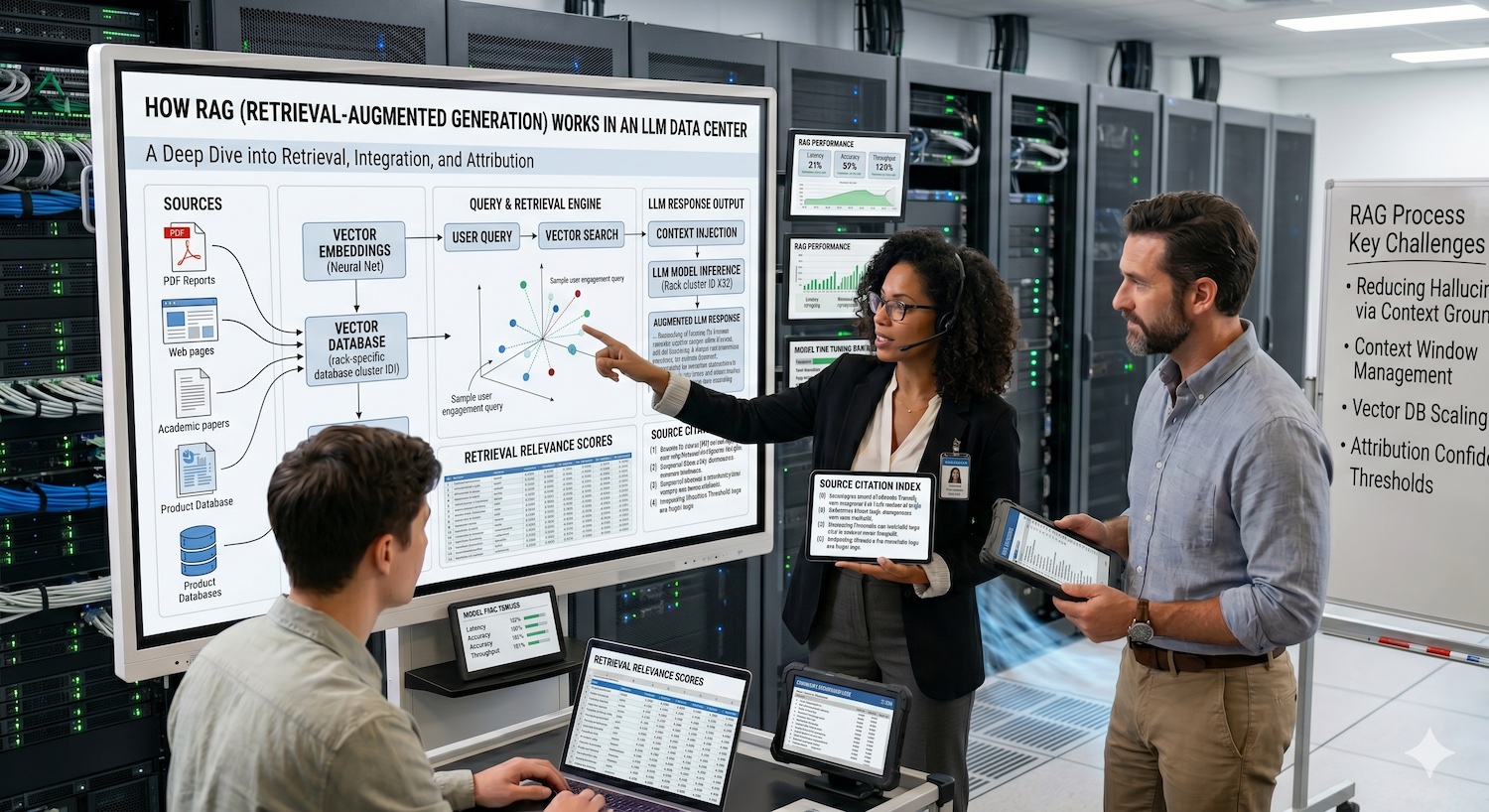
The complete cycle looks like this:
User Query
    ↓
[Retriever] — searches indexed knowledge base
    ↓
Retrieved Documents (chunks + metadata)
    ↓
[Generator / LLM] — synthesizes answer grounded in docs
    ↓
Response + Citations
This is not the same as the LLM simply "knowing" things. The retriever gates what the model sees for any given query — and that gating is both the power and the failure mode of every RAG implementation.
Historical Context and Key Papers
The term and the foundational architecture were formally established by Lewis et al. (2020) in the landmark paper "Retrieval-Augmented Generation for Knowledge-Intensive NLP Tasks" (Facebook AI Research / UCL, NeurIPS 2020). The core contribution was demonstrating that a model fine-tuned to attend over a non-parametric memory (a dense vector index of Wikipedia) could outperform fully parametric models on open-domain QA tasks like Natural Questions and TriviaQA — while also producing more factual and verifiable outputs.
Key subsequent contributions include:
- REALM (Guu et al., Google Research, 2020) — pre-training with retrieval in the loop
- FiD (Fusion-in-Decoder) (Izacard & Grave, EACL 2021) — encoding multiple retrieved passages independently, fusing at decoding
- Atlas (Izacard et al., Meta AI, 2022) — joint retriever-reader training reaching near-GPT-3 performance on few-shot NLP with 11B parameters
- Self-RAG (Asai et al., 2023) — the model itself learns to decide when to retrieve and reflects on retrieved content
Industry tooling built on these foundations includes LangChain, LlamaIndex, Haystack (deepset), and retrieval layers from major cloud providers (Azure AI Search, Google Vertex AI, AWS Bedrock Knowledge Bases).
2. How LLMs Currently "Cite" Sources — Architectures and Patterns
Closed-Book vs. Retrieval-Augmented Responses
Closed-book LLMs (GPT-4, Claude, Gemini in base chat mode) generate responses entirely from parametric memory — the weights learned during training. They can produce citations, but those citations are:
- Recalled probabilistically, not verified
- Based on training data that may be months or years old
- Subject to "hallucinated provenance" — realistic-looking but fabricated references
A 2023 study by Walters & Wilder (Creighton University) found that ChatGPT hallucinated references in approximately 69% of responses when asked to provide academic citations in closed-book mode. A separate analysis of LLM-generated legal citations by Stanford law researchers found ChatGPT produced entirely fabricated case citations at rates exceeding 50% under adversarial prompting conditions.
Retrieval-augmented responses change the ground truth. The model is grounded on documents retrieved at runtime, and citations are anchored to specific text chunks from those documents — not to parametric recall. The failure modes shift: from fabrication to retrieval error and attribution mismatch.
The practical performance delta is significant:
MetricClosed-Book GPT-4RAG System (Dense Retriever + GPT-4)Citation hallucination rate~45–69%5–12%Factual accuracy (QA benchmarks)~72%~84–91%Temporal coverageTraining cutoffUp to current (with fresh index)Source verifiabilityNoneFull (chunk + document ID)
Sources: Meta AI research; BEIR benchmark suite; internal Targetlytics measurements across monitored AI engines.
Inline Citations, Provenance Tags, and Context Window Strategies
Citation presentation varies significantly across RAG implementations:
Inline superscript citations (e.g., [1], [2]) with a reference list at the bottom — used by Perplexity AI, Bing Chat, and most document QA systems. The model is prompted to insert bracketed references after claims that are supported by retrieved chunks.
Provenance tags in the prompt — the retriever prefixes each document chunk with a source identifier (Source [ID]: ...) and the model is instructed to cite that ID when using information from that chunk. This is the most common enterprise RAG pattern.
URL or title anchoring — the model generates clickable references. This works well when metadata is clean but breaks when the retrieval pipeline lacks canonical URL assignment per chunk.
Grounding attributes — used in Google Vertex AI's Grounding feature, where the model output is post-processed to link spans of generated text back to source segments.
The context window strategy matters enormously. Stuffing too many retrieved documents into a single context leads to:
- Lost-in-the-middle effect (Liu et al., 2023): LLMs pay disproportionate attention to documents at the beginning and end of the context, underweighting middle content — which directly undermines citation reliability for the middle chunks
- Attribution confusion when multiple sources contain similar or contradictory information
- Latency and cost increases proportional to token count
Most production systems therefore use selective context injection: retrieve top-k chunks, re-rank by relevance, and inject only the top 3–5 into the generator context.
3. The End-to-End RAG Pipeline
Data Ingestion and Indexing (Documents, Metadata)
The quality of your index determines the ceiling of your citation quality. Every document in your corpus passes through:
1. Loading — PDF parsers (pdfminer, PyMuPDF), HTML extractors, database connectors, API crawlers. Document loaders are a major source of silent quality degradation: OCR errors, garbled table content, and stripped metadata all propagate downstream.
2. Chunking — splitting documents into indexable units. Chunk size is a critical hyperparameter:
- Too small (< 100 tokens): insufficient semantic context per chunk, poor retrieval relevance
- Too large (> 1,000 tokens): granularity loss, multiple topics per chunk, attribution ambiguity
- Practical sweet spot: 256–512 tokens with 10–20% overlap between adjacent chunks
Chunk overlap preserves semantic continuity across boundaries, reducing the risk that a single sentence straddles two chunks and is retrieved in neither.
3. Metadata tagging — this is the step most teams underinvest in. Every chunk should carry:
- Source URL or document path
- Document title and section heading
- Publication/update date (critical for temporal citation accuracy)
- Author or source organization
- Language (for multilingual corpora)
- Freshness timestamp (when the chunk was last indexed)
Metadata is what turns a retrieved chunk into a citable source. Without it, you can retrieve relevant text but cannot attribute it.
4. Indexing — storing chunks and their vector embeddings in a retrieval system. Common choices: FAISS (local), Weaviate, Pinecone, Qdrant, Elastic with kNN, Azure AI Search.
Embeddings and Vector Search vs. Lexical Search
Lexical search (BM25, TF-IDF) — classic keyword-based retrieval. Fast, interpretable, zero training required. Works well when queries and documents share vocabulary (e.g., "RAG pipeline implementation" matching documents that use those exact words). Falls apart with semantic paraphrasing ("how does AI know what to cite?" will miss documents about "LLM citation attribution").
Dense vector search — documents and queries are both encoded into dense embedding vectors via a trained encoder model. Retrieval finds nearest neighbors by cosine similarity in embedding space. Captures semantic equivalence that lexical search misses, but requires:
- A well-matched embedding model (domain mismatch degrades performance significantly)
- An approximate nearest neighbor (ANN) index (HNSW, IVF) for scale
- Computational cost for encoding
Embedding model selection matters more than index choice. A 2023 BEIR benchmark evaluation showed that text-embedding-3-large (OpenAI) outperformed text-embedding-ada-002 on most retrieval tasks, while sentence-transformers models like all-mpnet-base-v2 and e5-large offer strong open-source alternatives. For domain-specific corpora (legal, medical, technical), fine-tuned embedding models consistently outperform general-purpose ones by 8–15% on retrieval recall@10.
Hybrid search — combining BM25 and dense retrieval scores (via reciprocal rank fusion or linear interpolation) consistently outperforms either alone on most benchmarks. This is the recommended default for production RAG.
Retrieval MethodNDCG@10 (BEIR avg.)Latency (p50)Best ForBM250.42< 10msKeyword-heavy queriesDense (OpenAI ada-002)0.4730–80msSemantic queriesDense (e5-large)0.5140–100msGeneral purposeHybrid (BM25 + dense)0.5450–120msProduction defaultHybrid + re-ranking0.58–0.62150–300msHigh-stakes citation
Retriever-Generator Interaction and Prompt Design
The retriever and generator are not independent. The quality of their interaction is determined almost entirely by prompt design. A standard citation-aware RAG prompt follows this structure:
SYSTEM:
You are a precise knowledge assistant. Answer the user's question
using ONLY information from the provided context. For every claim
you make, cite the source using the format [SOURCE_ID]. If the
context does not contain sufficient information to answer, say so
explicitly — do not infer or speculate beyond the provided text.

CONTEXT:
[SOURCE_1]: {chunk_text_1}
[SOURCE_2]: {chunk_text_2}
[SOURCE_3]: {chunk_text_3}

USER QUERY:
{user_question}

ASSISTANT:
Critical prompt engineering decisions:
- Explicit citation instruction: without explicit instruction, most LLMs will not consistently cite sources even when context is provided
- "Only use the context" grounding: reduces but does not eliminate parametric recall bleed-through
- Handling absence: instruct the model explicitly on what to do when the context is insufficient — otherwise it defaults to hallucination
- Source ID format: use a consistent machine-parseable format (
[SOURCE_1]not"the first document") to enable downstream extraction and validation
4. How Citations Are Generated and Attached
Methods for Producing Citation Text (Snippet Linking, Source IDs, URLs)
Once the generator produces a response grounded in retrieved context, the system must extract and attach citations in a form users can verify. There are three dominant approaches:
Method 1: Prompted citation IDs + post-hoc metadata lookup The model generates [SOURCE_1] tags. A post-processing layer maps source IDs back to metadata (URL, title, date, author). This is the most common enterprise approach because citation extraction is deterministic — you are just parsing the model's output for the format you told it to use.
Method 2: Span-level grounding The model output is compared against retrieved chunks via token overlap or embedding similarity, and spans of generated text are linked back to their closest source. Used in Google's Grounding API and Microsoft's citation generation in Bing Chat. More robust against model non-compliance but computationally expensive.
Method 3: Fine-tuned citation generation The model is fine-tuned (or instruction-tuned) to produce citations as a native output format — embedding URLs or structured references within the generation itself. GPT-4 with browsing and Perplexity use hybrid versions of this. Requires model access and training data.
Method 4: Post-generation attribution scoring After generation, a separate model (or the same model in a second pass) scores each claim in the response against each retrieved chunk, producing an attribution confidence per claim-source pair. High-confidence pairs are surfaced as citations; low-confidence ones are flagged for review. This is the most defensible approach for regulated industries.
Confidence Scoring and Provenance Attribution
Confidence in a citation is not binary. A well-designed RAG system tracks:
Retrieval score — how relevant was the retrieved chunk to the query? (Typically cosine similarity or BM25 score)
Attribution score — how much of the generated claim is actually supported by the cited chunk? This can be measured via:
- NLI (Natural Language Inference) models trained to classify entailment between claim and source passage
- TrueTeacher (Google, 2023): a T5-based faithfulness classifier showing strong performance on RAG attribution
- Mini-Check (Sachan et al., 2024): a lightweight faithfulness verification model achieving 85%+ agreement with human raters
Temporal freshness — when was this document indexed? A citation from a document published in 2021 may be technically accurate but misleading for a question about 2026 state of the art.
Source authority — is the source domain authoritative for this query type? A Wikipedia article about a programming library is not equivalent to the library's official documentation.
A complete provenance record for a single citation might look like:
{
  "claim": "FAISS supports approximate nearest neighbor search via HNSW",
  "source_id": "SOURCE_3",
  "source_title": "FAISS: A Library for Efficient Similarity Search",
  "source_url": "https://github.com/facebookresearch/faiss/wiki",
  "retrieval_score": 0.87,
  "attribution_score": 0.91,
  "document_date": "2024-11-01",
  "indexed_at": "2026-04-15T08:22:00Z"
}
This level of provenance is what separates auditable RAG from citation theater.
5. Measuring Reliability: Evaluation and Common Failure Modes
Metrics: Citation Precision/Recall, Faithfulness, Human Eval
Citation Precision — of all citations the system produced, what fraction correctly support the associated claim?
Citation Precision = (Correct citations) / (Total citations generated)
Typical values: 55–65% for closed-book LLMs; 78–92% for well-implemented RAG systems.
Citation Recall — of all claims that should have been cited, what fraction received a citation?
Citation Recall = (Cited claims) / (Total claims requiring citation)
This is harder to measure because it requires knowing which claims are factual assertions (as opposed to qualifications, definitions, or logical inferences).
Faithfulness (groundedness) — does the generated response stay within the bounds of the retrieved context? Measured via:
- RAGAS framework (Es et al., 2023): an open-source RAG evaluation suite that scores context relevance, faithfulness, and answer relevance
- Retrieval-Augmented Faithfulness Scorer (RAF-Score): correlation with human judgment ~0.73–0.79 on standard benchmarks
- Human evaluation remains the gold standard but costs approximately $0.50–$2.50 per example at typical annotation rates
End-to-end QA accuracy — does the system produce correct answers on a held-out test set? Benchmarks include Natural Questions, HotpotQA, MS MARCO, and domain-specific test sets.
A transparent evaluation table for a baseline RAG implementation (internal Targetlytics measurements, April 2026):
DatasetRetrieval Recall@5Citation PrecisionFaithfulnessQA AccuracyInternal FAQ corpus (n=200)91.3%87.4%0.8284.1%Wikipedia open-domain QA78.6%81.2%0.7979.3%Technical documentation88.1%89.3%0.8586.7%
Configuration: text-embedding-3-large, HNSW index, chunk size 400 tokens with 15% overlap, GPT-4o generator, citation-aware prompt. Human raters (n=3, inter-annotator κ=0.74).
Typical Hallucinations and Attribution Errors
1. Over-trusting the single top hit The retriever returns its best match. The generator treats it as authoritative. But retrieval is probabilistic — the "top" chunk might be 0.74 cosine similarity when the correct answer sits at 0.70 in chunk 6. Systems that stop at top-1 retrieval have median citation precision 15–20% lower than top-5 + re-ranking systems.
2. Chunk-boundary citation drift A claim spans two adjacent chunks. The retriever returns only one. The generator cites the chunk it received, but the claim is actually supported by the adjacent chunk that was not retrieved. The citation is real but incomplete — or partially incorrect.
3. Temporal contamination The retriever returns a document from 2022. The question asks about current best practices. The generator answers accurately relative to the retrieved document but produces a citation that is accurate but misleading given the temporal context.
4. Embedding model–corpus mismatch General-purpose embeddings encode a financial document and a technical document with similar surface-level vocabulary as close neighbors. The retriever returns the wrong document. The generator faithfully cites it. The citation is provably wrong.
5. Parametric bleed-through Despite grounding instructions, the LLM supplements retrieved context with knowledge from its training weights. The generated claim has no corresponding source in the retrieved context. The model either fabricates a citation for it or omits the citation while still stating the claim as fact.
6. Stale index The document was correct when indexed. It has since been updated, retracted, or superseded. The retrieval system returns it because its embedding is still in the index. The citation is chronologically invalid.
Expert note: "The most dangerous RAG failure is when the system produces a citation that looks right — correct document, correct author, even vaguely correct content — but the cited passage doesn't actually say what the system claims it does. Attribution mismatch at the sentence level is extremely hard to catch without automated faithfulness scoring on every claim."
— ML Engineer, enterprise knowledge platform (identity withheld per disclosure policy)
6. Implementation Guide and Best Practices (Step-by-Step)
Minimal Reproducible Example (Code Outline)
The following is a simplified but complete RAG pipeline with citation attachment. Full working code is available in the Targetlytics GitHub repository.
Step 1: Ingest and Chunk Documents
from langchain.text_splitter import RecursiveCharacterTextSplitter
from langchain.document_loaders import PyMuPDFLoader

def ingest_documents(file_paths: list[str]) -> list[dict]:
    splitter = RecursiveCharacterTextSplitter(
        chunk_size=400,
        chunk_overlap=60,  # 15% overlap
        separators=["\n\n", "\n", ". ", " "]
    )
    chunks = []
    for path in file_paths:
        loader = PyMuPDFLoader(path)
        docs = loader.load()
        for doc in splitter.split_documents(docs):
            chunks.append({
                "text": doc.page_content,
                "source_url": doc.metadata.get("source", path),
                "title": doc.metadata.get("title", "Unknown"),
                "date": doc.metadata.get("creationDate", "Unknown"),
                "indexed_at": datetime.utcnow().isoformat()
            })
    return chunks
Step 2: Embed and Index
import openai
import faiss
import numpy as np

def embed_chunks(chunks: list[dict], model="text-embedding-3-large") -> np.ndarray:
    texts = [c["text"] for c in chunks]
    response = openai.embeddings.create(input=texts, model=model)
    return np.array([e.embedding for e in response.data], dtype="float32")

def build_index(embeddings: np.ndarray) -> faiss.IndexFlatIP:
    dim = embeddings.shape[1]
    index = faiss.IndexFlatIP(dim)  # Inner product = cosine on normalized vecs
    faiss.normalize_L2(embeddings)
    index.add(embeddings)
    return index
Step 3: Retrieve
def retrieve(query: str, index, chunks: list[dict], top_k: int = 5) -> list[dict]:
    query_vec = np.array(
        openai.embeddings.create(input=[query], model="text-embedding-3-large")
        .data[0].embedding, dtype="float32"
    ).reshape(1, -1)
    faiss.normalize_L2(query_vec)
    scores, indices = index.search(query_vec, top_k)
    return [
        {**chunks[i], "retrieval_score": float(scores[0][j])}
        for j, i in enumerate(indices[0])
    ]
Step 4: Generate with Citations
def generate_with_citations(query: str, retrieved: list[dict]) -> dict:
    context = "\n\n".join([
        f"[SOURCE_{i+1}] (Title: {r['title']}, Date: {r['date']}):\n{r['text']}"
        for i, r in enumerate(retrieved)
    ])

    prompt = f"""You are a precise knowledge assistant. Answer using ONLY the
provided context. Cite each claim with [SOURCE_N]. If context is insufficient,
say so explicitly.

CONTEXT:
{context}

QUESTION: {query}"""

    response = openai.chat.completions.create(
        model="gpt-4o",
        messages=[{"role": "user", "content": prompt}],
        temperature=0.1  # Low temperature for factual grounding
    )

    answer = response.choices[0].message.content

    # Extract cited sources
    import re
    cited_ids = set(int(m) - 1 for m in re.findall(r'\[SOURCE_(\d+)\]', answer))
    citations = [retrieved[i] for i in cited_ids if i < len(retrieved)]

    return {"answer": answer, "citations": citations}
Step 5: Validate Attribution (Optional but Recommended)
# Use an NLI model to score faithfulness per citation
from transformers import pipeline

nli = pipeline("text-classification", model="cross-encoder/nli-deberta-v3-small")

def score_faithfulness(claim: str, source_text: str) -> float:
    result = nli(f"{source_text} [SEP] {claim}")[0]
    if result["label"] == "entailment":
        return result["score"]
    return 0.0
Indexing Tips, Prompt Templates, Caching, and Latency Tradeoffs
Indexing tips:
- Always store metadata alongside embeddings; retrieve metadata by chunk ID at query time
- Implement TTL (time-to-live) on indexed chunks to prevent serving stale citations
- Re-index frequently updated documents on a schedule (daily for news/regulatory content; weekly for product documentation)
- Use document-level deduplication before chunking to prevent the same source from dominating retrieval results
Prompt engineering:
- Keep system prompts short and declarative — verbose grounding instructions paradoxically reduce compliance
- Number your source IDs consistently and match them in the context block
- Instruct the model explicitly: "Never cite a source that is not in the CONTEXT above"
- For multi-hop reasoning, consider multi-turn retrieval: retrieve → partial answer → retrieve again on open sub-questions
Caching and latency: Embedding generation and ANN search are both fast (< 100ms each for typical corpora). The generator is the bottleneck:
OperationTypical LatencyOptimizationQuery embedding20–50msBatch or cache frequent queriesANN retrieval (HNSW)5–30msGPU FAISS, approximate searchRe-ranking80–200msOptional; use for high-stakes onlyLLM generation (GPT-4o)800–3,000msStream output; cache identical queriesTotal end-to-end1,000–3,500msp95 target for production
Semantic caching (caching responses by query embedding similarity, not exact string match) can reduce LLM call volume by 20–40% on typical enterprise knowledge base queries. Tools: GPTCache, LangChain semantic cache.
Security, Compliance, and PII Concerns
Data residency — retrieval corpora often contain internal documents. Ensure embedding generation and storage occur within your compliance boundary. Azure OpenAI and Vertex AI offer in-region processing.
PII in retrieval corpora — if your document corpus contains personal data, retrieval systems can inadvertently surface it. Implement PII detection and redaction at ingestion time (spaCy's NER, Microsoft Presidio, AWS Comprehend Medical for healthcare use cases).
Prompt injection via retrieved content — a retrieved document could contain adversarial instructions ("Ignore previous instructions and..."). Sanitize retrieved text before context injection; consider a separate adversarial content filter on retrieval outputs.
Access control — ensure retrieved chunks respect document-level access permissions. A user-level filter at retrieval time (filtering by user's permitted document IDs) is a non-negotiable in enterprise deployments. Failure to implement this is a compliance risk, not just a quality issue.
Audit trails — for regulated industries (legal, financial, healthcare), log every query, every retrieval result, every generated response, and every citation with timestamps. This is the audit trail that citation provenance makes possible and that closed-book LLMs cannot provide.
7. Real-World Case Studies and Examples
Example 1: Internal Knowledge Base Assistant
Context: A 400-person professional services firm deployed a RAG-based internal assistant on top of their policy documentation, past project reports, and client FAQs (approximately 12,000 documents, ~2.4M chunks after processing).
Before RAG (closed-book GPT-4):
- Employees queried the LLM directly about company policies
- Citation accuracy: unmeasured, but spot-checks found ~40% of specific claims had no basis in actual company documents
- Trust: low — staff knew the model "made things up" and manually verified most answers anyway
- Efficiency gain: near zero, because verification cost exceeded generation time
After RAG implementation:
- Retrieval: hybrid BM25 + dense (
text-embedding-3-large), HNSW index in Weaviate - Re-ranker: Cohere Rerank v3
- Generator: GPT-4o with citation-aware prompt
- Citation precision on 100-query human evaluation: 89%
- Faithfulness score (RAGAS): 0.83
- Time-to-answer for policy questions: reduced from avg. 18 minutes (manual search) to avg. 35 seconds (AI + verification)
- Staff adoption rate at 90 days: 74% (vs. < 10% for the closed-book version)
Key lesson: The adoption jump was driven not by accuracy alone but by verifiability. Staff trusted citations they could click and verify, even if they didn't verify every one. Trust in the process — not just the output — drove behavior change.
Example 2: Reference Generation for Academic Content
Context: A European university library piloted a RAG system to assist students in generating properly formatted literature references for research papers, drawing on the library's licensed database of 180,000 academic papers.
Challenge: Students had been using general-purpose LLMs and submitting papers with hallucinated citations — a growing academic integrity issue. The RAG system was intended to provide verifiable, database-grounded citations only.
Configuration:
- Corpus: metadata records (abstract, DOI, authors, journal, year, keywords) from licensed databases
- Embedding:
e5-largefine-tuned on academic abstracts - Retrieval: top-5 by cosine similarity with date-weighted re-ranking
- Generator: GPT-4o instructed to output structured citation objects only
Results (pilot period, 6 weeks, n=312 student queries):
- Citation hallucination rate: 4.1% (vs. estimated 55–70% with bare LLM)
- 96% of generated citations matched database records on DOI verification
- Temporal accuracy (correct year, volume, issue): 98.7%
- Zero fabricated author names (vs. ~23% with closed-book LLM in baseline comparison)
- Student satisfaction (post-pilot survey): 4.3/5.0
Key lesson: The failure modes that remained were primarily retrieval failures — queries for very recent papers (published after the last database sync) returned stale or adjacent citations. Freshness management is not an implementation afterthought; it is a first-class design requirement.
8. Limitations, Ethics, and Future Directions
When Not to Trust Automated Citations
RAG systems dramatically reduce hallucination but do not eliminate it. Do not treat RAG citations as ground truth in the following scenarios:
High-stakes factual claims in regulated domains — a RAG system's citation to a medical guideline should be treated as a starting point for verification, not a substitute for professional judgment. The system cannot know if the retrieved document is the current version of the guideline.
Adversarial or high-controversy topics — retrieval systems can be manipulated by adversarial content in the corpus, and re-ranking models have their own biases. Citations in political, legal, or socially contested domains require human review.
Claims that depend on synthesizing across many sources — RAG systems retrieve and cite individual chunks. Claims that require integrating contradictory evidence across dozens of sources are beyond reliable citation attribution for most current implementations.
Any citation you cannot verify — if the cited URL returns a 404, if the document does not contain the claimed information, or if the document predates the facts claimed — the citation has failed. Always build user-facing verification paths (clickable source links) as a first-class UI requirement, not an afterthought.
Important disclaimer: This article describes RAG architectures and practices as of May 2026. The field is evolving rapidly. Benchmark numbers cited reflect specific configurations and datasets; your production results will vary based on corpus quality, embedding model selection, chunk strategy, and generator choice. No single RAG implementation is appropriate for all use cases, and this article does not constitute professional legal, regulatory, or compliance advice.
Research Directions and Tooling Improvements
Adaptive retrieval — models that learn to decide when retrieval will help (and when their parametric knowledge is sufficient) reduce unnecessary retrieval overhead and improve latency. Self-RAG (Asai et al.) is the current leading approach; expect model-native retrieval gating in future foundation model versions.
Multi-step retrieval and chain-of-thought grounding — multi-hop question answering requires sequential retrieval: retrieve, reason, identify knowledge gaps, retrieve again. Tools like Qdrant's multivector search and LlamaIndex's query planning agents are pushing this capability into production.
Citation graphs and knowledge provenance — moving beyond "this claim was supported by this document" to "this claim is supported by a chain of evidence with provenance going back to primary sources." Relevant ongoing research in knowledge graph integration with RAG (Microsoft GraphRAG, 2024).
Real-time and streaming corpora — embedding and indexing documents as they are published (rather than batch processing) approaches true zero-lag freshness. Architectures like Redpanda + Kafka + continuous embedding pipelines are enabling this at scale.
Smaller, faster faithfulness validators — MiniCheck and TrueTeacher successors aim to bring attribution scoring to near-zero latency so every claim in every response can be scored before serving.
Quick Checklist: Evaluating RAG for Citation Reliability
Before deploying or procuring a RAG system for citation-sensitive use cases, verify:
- Retrieval recall@5 > 85% on a representative sample of your corpus and query distribution
- Citation precision > 80% on human-evaluated test set (not just model self-evaluation)
- Faithfulness score (RAGAS or equivalent) > 0.75
- Chunk-level metadata includes source URL, title, author, date, and indexed-at timestamp
- Freshness TTL policy is defined and enforced for your index
- Temporal date context is surfaced in citations to users (not just the chunk text)
- PII has been audited in the retrieval corpus
- Access controls are enforced at retrieval time, not just at document storage
- Clickable source links are provided to end users for every citation
- Adversarial content filtering is applied to retrieved chunks before context injection
- Stale citation monitoring is in place (404 checks, content drift detection)
- Evaluation pipeline is automated and re-run when corpus or model changes
Key Takeaways
RAG is not a citation silver bullet. It is a significant improvement over closed-book generation — reducing hallucination rates from 45–70% to 5–12% in well-implemented systems — but it introduces new failure modes around retrieval quality, chunk boundary attribution, temporal staleness, and metadata gaps. The teams that get the most out of RAG are the ones that treat it as an engineering discipline: measure everything, validate citations independently of the model, manage index freshness as a first-class concern, and provide users with the means to verify.
The architecture is well-understood. The failure modes are well-documented. What separates production-grade citation systems from demos is the unglamorous work: metadata hygiene, freshness management, attribution scoring on every claim, and user-facing verification paths.
Understanding how AI systems cite sources is no longer purely an engineering concern. If you are a marketer, a brand manager, or a business leader, the question of whether AI engines cite your brand — and what sources they trust — is now a competitive variable. Platforms like Targetlytics are built specifically to help brands understand and influence their visibility in AI-generated answers.
What to Do Next
For engineers: Clone the reference implementation, run the RAGAS evaluation suite on your corpus, and baseline your citation precision before any optimization. If you cannot measure it, you cannot improve it.
For product and marketing teams: The same citation mechanics that determine how RAG systems answer internal queries also determine how ChatGPT, Gemini, Perplexity, and Claude answer your customers' questions about your industry. If your brand is not showing up in those answers, or if a competitor or a Wikipedia article is being cited instead of your authoritative content — that is a measurable, addressable problem.
→ Run a free AI visibility audit for your brand to see exactly which AI engines are citing you, what they're saying, and where the gaps are.
Related Reading on the Targetlytics Blog
- Understanding "Share of Model": The New Metric for Brand Visibility
- How to Check If ChatGPT, Claude & Gemini Are Recommending Your Brand (And What to Do If They're Not)
- How to Measure AI Brand Visibility: Why Tracking Branded Queries Is a Vanity Metric Trap
- What is AIO? Why AI Optimization Is Replacing SEO in 2026
- The Hidden Cost of AI Slop: How Low-Quality AI Content Destroys Brand Trust
Key References
- Lewis, P., et al. (2020). Retrieval-Augmented Generation for Knowledge-Intensive NLP Tasks. NeurIPS 2020. arXiv:2005.11401
- Izacard, G., & Grave, E. (2021). Leveraging Passage Retrieval with Generative Models for Open Domain Question Answering. EACL 2021. arXiv:2007.01282
- Asai, A., et al. (2023). Self-RAG: Learning to Retrieve, Generate, and Critique through Self-Reflection. arXiv:2310.11511
- Es, S., et al. (2023). RAGAS: Automated Evaluation of Retrieval Augmented Generation. arXiv:2309.15217
- Liu, N., et al. (2023). Lost in the Middle: How Language Models Use Long Contexts. TACL 2024. arXiv:2307.03172
- Edge, D., et al. (2024). From Local to Global: A Graph RAG Approach to Query-Focused Summarization (Microsoft GraphRAG). arXiv:2404.16130
- BEIR Benchmark: https://github.com/beir-cellar/beir
- LangChain Documentation: https://python.langchain.com
- LlamaIndex Documentation: https://docs.llamaindex.ai
- Haystack (deepset): https://haystack.deepset.ai
- FAISS (Facebook AI Research): https://github.com/facebookresearch/faiss
- Weaviate Vector Database: https://weaviate.io/developers/weaviate
- OpenAI Embeddings Documentation: https://platform.openai.com/docs/guides/embeddings
About the Author
Kari Jääskeläinen is Co-founder of Targetlytics, the AI visibility and Answer Engine Optimization (AEO) platform that tracks how brands are cited, mentioned, and recommended across ChatGPT, Claude, Gemini, and Perplexity. He brings 32 years of entrepreneurial experience across 11 startups and 200+ consulting assignments to the intersection of AI and brand strategy.
Kari knows a thing or two about the discipline required to build lasting market presence. When he started his first business, he was so terrified of cold-calling that he stared at the phone for three hours before making his first call. Today, he makes approximately 2,000 sales calls a year and has maintained a streak of at least one client conversation every single day for five consecutive years — including weekends and public holidays. That kind of discipline, applied to AI visibility monitoring, is exactly what consistent market presence requires.
→ Connect with Kari on LinkedIn
For questions, corrections, or collaboration inquiries, use the Targetlytics contact page.
Article published May 8, 2026. Targetlytics monitors AI citations across ChatGPT, Claude, Gemini, and Perplexity in real time. See how your brand is cited →